Access governance
Access governance that doesn’t feel like a tax
Access governance is how you prove — to auditors, to leadership, and to yourself — that the right people have the right access, and nobody kept access they no longer need. For a 30–200 person company that usually means a spreadsheet that goes stale the day you save it. Useboards gives you real governance — access reviews, requests, onboarding/offboarding, and audit evidence — without standing up an enterprise identity-governance platform.
Save 50% your first year — code EARLYBIRD50
14-day sandbox · pre-seeded demo data · no credit card · 2-minute setup
What access governance actually requires
At its core, access governance is four repeatable loops. Miss any one and an auditor (or an incident) will find the gap.
- Provisioning: access is granted through an approval, not a Slack DM — with a record of who approved it and why.
- Certification: someone accountable periodically confirms each person still needs their access (the user access review).
- Deprovisioning: when someone leaves or changes roles, their access is removed promptly and provably.
- Evidence: every grant, approval, review, and revocation is logged in a tamper-evident trail you can hand to an auditor.
Why spreadsheets break down
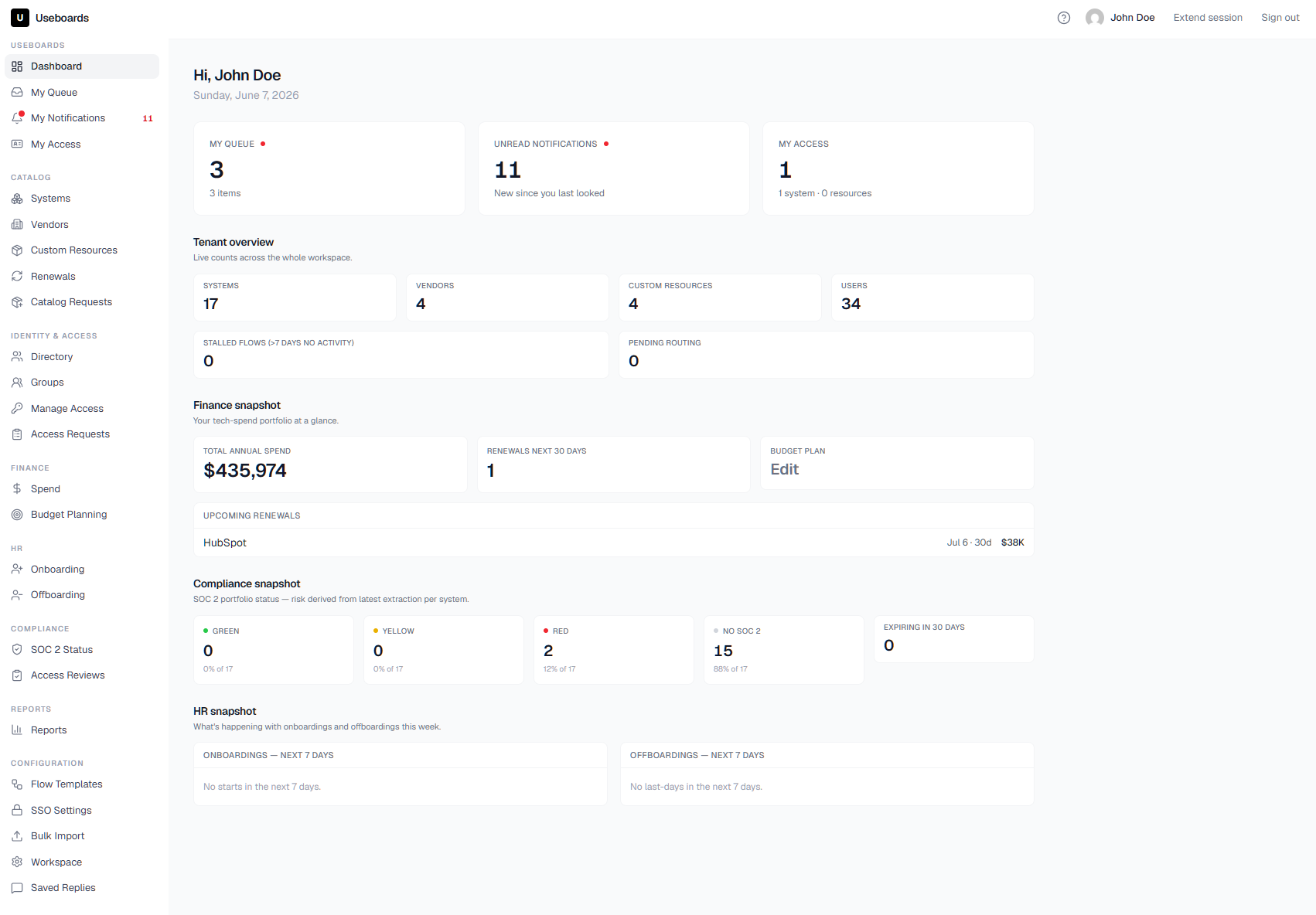
A spreadsheet has no approval flow, no immutable history, and no reminder that a review is due. It records what someone remembered to type, once. When the SOC 2 auditor asks “show me the access review you ran in Q2, and who approved this person’s admin rights,” the spreadsheet can’t answer. Useboards keeps the same simplicity — you still see a clear list of who has what — but every change is an auditable event.
How Useboards handles it
Everything runs off a single system catalog — every SaaS app, vendor, and internal resource, with its owners and access levels. From there:
- Access requests route through configurable approval flows (per system, per access level).
- User access reviews snapshot access at review-start so evidence can’t drift, and export a CSV pack for auditors.
- Onboarding and offboarding fan out the right grants and revocations, with replacement tickets routed to the right owners.
- An append-only audit log captures every action, tenant-isolated and retained for years.

See it with your own data — free, no credit card.
Save 50% your first year — code EARLYBIRD50
14-day sandbox · pre-seeded demo data · no credit card · 2-minute setup
Too big for spreadsheets, too small for enterprise IGA
Enterprise identity-governance platforms are built for large, complex organizations with dedicated IAM teams and multi-stage implementations. If that’s not you, they’re overkill — a long rollout to solve a problem you have today. Useboards is deliberately the layer in between: real governance, set up in an afternoon, priced for a team that just needs to pass its audit and stop managing access by memory.
Frequently asked questions
What is access governance?
Access governance is the set of controls that ensure people have appropriate access to systems and data, and that access is reviewed, approved, and revoked through an auditable process. It covers provisioning, periodic certification (access reviews), deprovisioning, and evidence.
Is access governance the same as IAM?
They overlap. Identity and access management (IAM) is primarily about authenticating users and enforcing access at login (SSO, MFA, provisioning). Access governance sits on top — it’s about oversight: who approved this access, is it still needed, and can you prove it. Useboards focuses on the governance layer and integrates with your existing IAM/SSO.
Do we need access governance if we already use SSO?
Yes. SSO controls how people log in; it doesn’t decide who should have access to what, review it quarterly, or produce audit evidence. Most SOC 2 and ISO 27001 findings are about governance (reviews, offboarding, approvals), not authentication.
Related
Set up access governance in an afternoon
Access reviews, requests, onboarding & offboarding, and SOC 2 evidence — for teams under 200. $100/mo flat for the first 33 seats. No demo required.
Save 50% your first year — code EARLYBIRD50
14-day sandbox · pre-seeded demo data · no credit card · 2-minute setup